
Export your Flexitive design as a Static PDF file from the Export panel. PDF exports contain editable layers, can be exported with either RGB or CMYK, and can be used to share with clients or print your designs.
You can also use a PDF as an ideal jumping off point to convert a Flexitive export to a PSD. Once exported, open your PDF in a design tool such as Adobe Illustrator, and save your exports in a different file format like a PSD. You can also update your design to make it print-ready, adding requirements like bleeds, margins, or guides can be added as needed.
How to Export a Static PDF
Before exporting your design from Flexitive, you will need to Publish your design. Publishing automatically saves your design and ensures the latest changes are included in your export. Learn more about Publishing your Design.
To export a Static PDF:
1. In the Export panel, click the Fixed tab.
2. Under the Fixed tab, select Export as Static PDF.
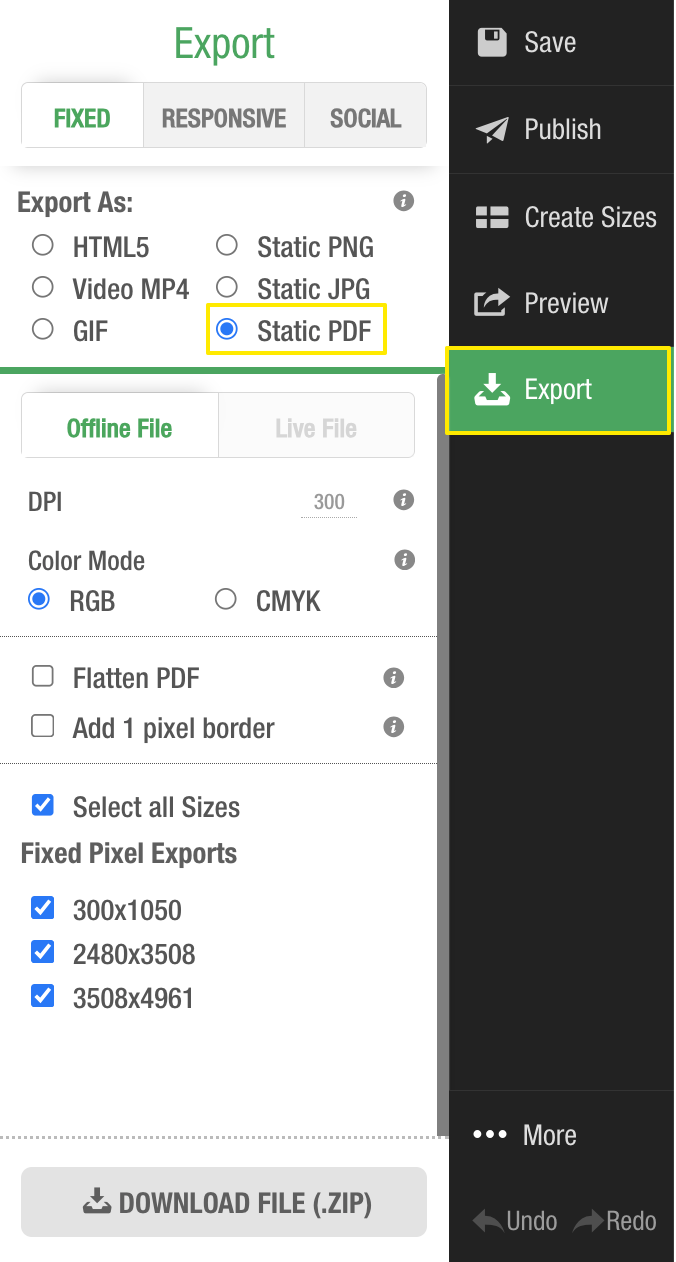
Once you've selected Static PDF, you can set the following properties:
* Available with Flattened PDFs only.
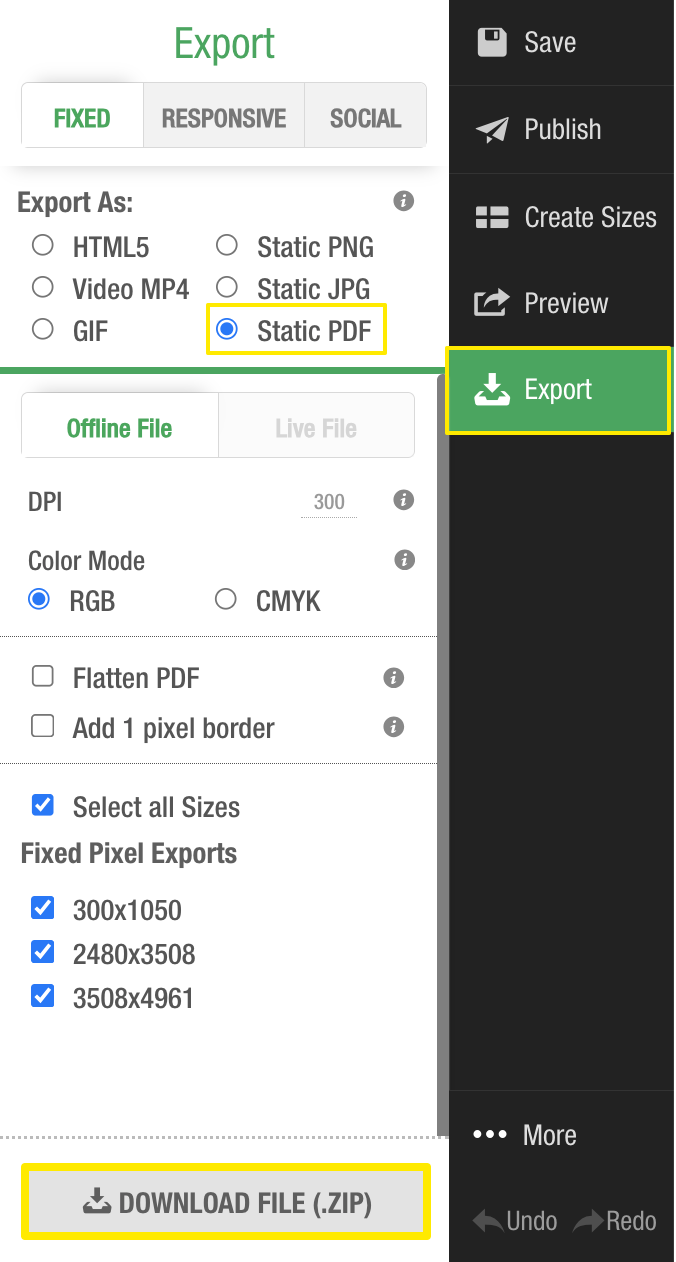
After selecting the properties you'd like applied to your PDF exports, select the sizes you'd like to export and click Download File (.ZIP). This will export a ZIP file containing PDF files of all the sizes you selected from your project.
Export Properties
DPI
- DPI (dots per inch) determines how densely pixels are printed on paper. Higher DPI values generate sharper images but also larger file sizes.
- DPI also affects the physical size of your design when printed. The pixel dimensions of the design remain the same, but higher DPI produces a smaller printed size with more detail, while lower DPI produces a larger printed size with less detail.
- For example: A design that is 3000 × 3000 pixels will print at:
- 10 × 10 inches at 300 DPI
- 20 × 20 inches at 150 DPI
- For example: A design that is 3000 × 3000 pixels will print at:
- By default, the DPI is set to 300
- Minimum DPI value is 72
- Maximum DPI Value is 1200.
Color Mode
- Color modes define how colors are created and displayed, depending on whether the design is intended for screens or print.
- Use the color mode buttons to select the color mode for your PDF export:
- RGB - Suitable for PDFs displayed digitally
- CMYK - Suitable for print PDFs.
Flatten PDF
- When selected, all elements in the PDF are merged into a single layer.
- Flattened PDFs have smaller file sizes and ensure a consistent appearance across devices and software.
- Flattening is only supported when exporting PDFs using RGB color mode.
- When deselected, elements remain on separate layers.
- Layered PDFs allow individual elements to be edited after export, useful for further design work or production workflows.
- Layered PDFs allow individual elements to be edited after export, useful for further design work or production workflows.
Static Image Quality
Only available if 'Flatten PDF' is selected
PNG and JPG image assets in your designs will automatically be compressed and cropped to the lowest possible file size without sacrificing image quality.
- If you would like to adjust the compression level of the images within your HTML5 file, you can use the Image Asset Quality field in the Export panel.
- Learn more about Adjusting Image Quality/Compression.
Export 2x Size Images
- Only available if 'Flatten PDF' is selected
- Turning on "Export 2x Size Images" will export your PDF at double the size of the original design. For example, an image with a resolution of 300x250 will instead export with a resolution of 600x500.
- Learn more about Exporting 2x Size Images.
Add a 1-Pixel Border
- When exporting a design from Flexitive, you can add a 1-pixel black border. Learn more about Adding a 1-Pixel Border.
Using Flexitive PDF Exports in Other Design Tools
Once exported from Flexitive, PDFs can be opened in a variety of design tools to review, refine, prepare files for final delivery, or save into other formats such as PSD without rebuilding designs from scratch.
How Flexitive PDF exports behave depends on the tool being used and the intended workflow. Below is a structured overview of what to expect for each supported tool.
In general, the best option to upload your layered PDF file to is 'Adobe Illustrator', as it fully preserves the layers of the PDF, allows for text editing, and can be used to prepare your design for use in Print. However, other editing tools can also be used if you do not have access to Adobe Illustrator.
| Design Tool | Supports Flexitive PDF Imports | Layers & Vectors Preserved | Text Fully Editable | Print Prep (Bleeds & Crops) | Exports To |
| Adobe Illustrator | ✔ | ✔ | ✔ | ✔ | Print PDF, SVG, PNG, JPG, AI, & PSD |
| Adobe InDesign | ✔ | ⚠ Limited | ✖ | ⚠ Limited | Print PDF (final layout) |
| Adobe Photoshop | ✔ | ⚠ Limited | ✖ | ✖ | PNG, JPG, TIFF, & PSD |
| Adobe Acrobat Reader | ✔ | ✖ | ✖ | ✖ | PDF only (view/share) |
Adobe Illustrator
Adobe Illustrator is our recommended tool to upload exported PDF files to for the purpose of converting the design to a PSD.
- Layers and vector elements are preserved
- Text remains fully editable
- Ideal for adding bleeds, crop marks, guides, and other print requirements
- Files can be re-exported or saved as PSDs if required.
Adobe InDesign
Adobe InDesign can open Flexitive PDF exports, but functionality is limited.
- Does not support SVG text embedded inside PDFs SVG-based text may be rasterized or fragmented on import (this is an InDesign limitation, not a Flexitive export or DPI issue)
- InDesign is not for print workflows.
Adobe Photoshop
Adobe Photoshop supports importing Flexitive PDF exports, but with limitations.
- Imports the design as a single flattened layer
- Best suited for visual review or basic image adjustments
- Photoshop is not recommended when layered or editable elements are required, or for print workflows.
Adobe Acrobat Reader
Adobe Acrobat Reader fully supports Flexitive PDF files for viewing purposes.
- Ideal for proofing, approvals, and sharing
- Maintains visual fidelity of the design
- Acrobat Reader is not intended for editing a PDF in any way.